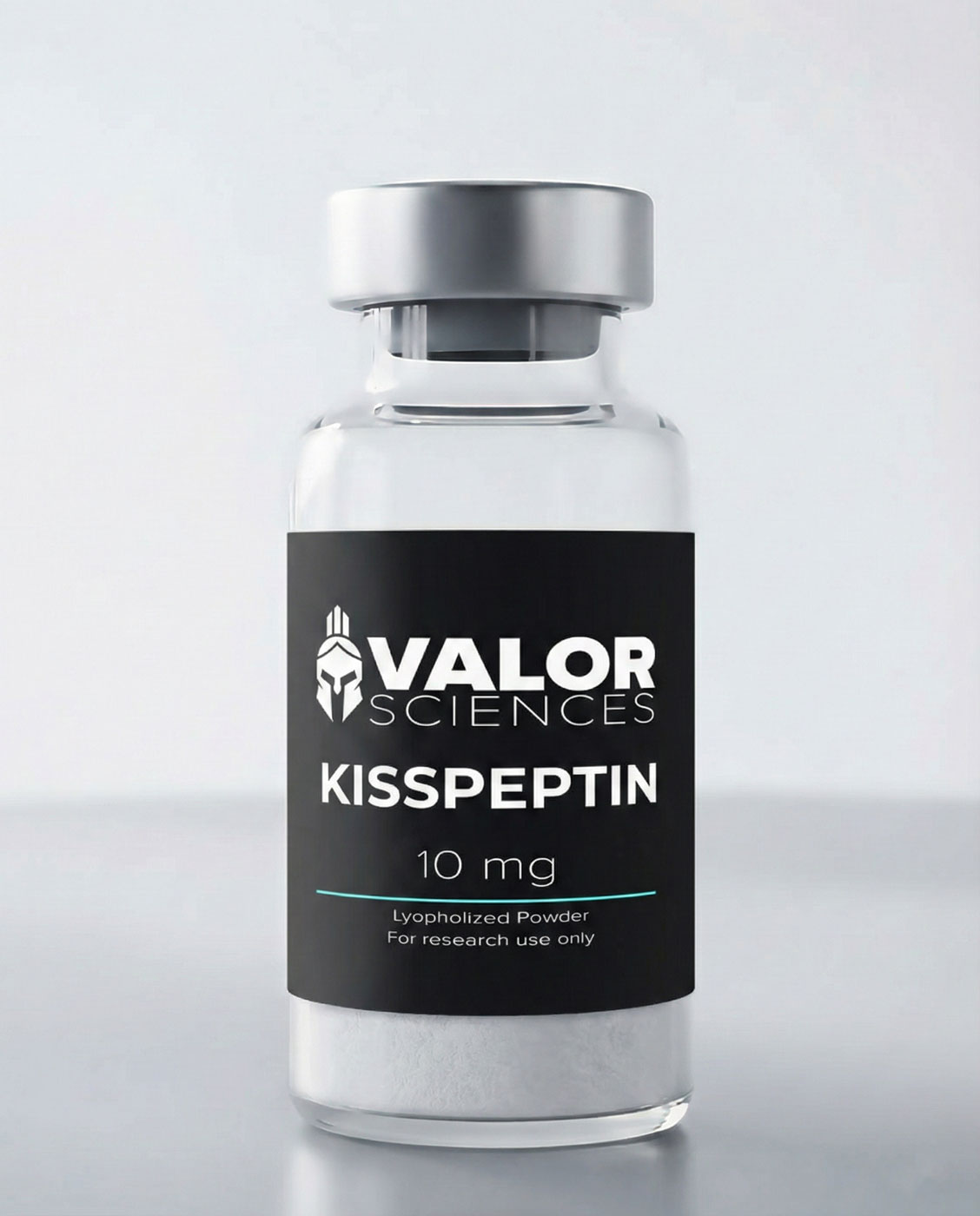
Description
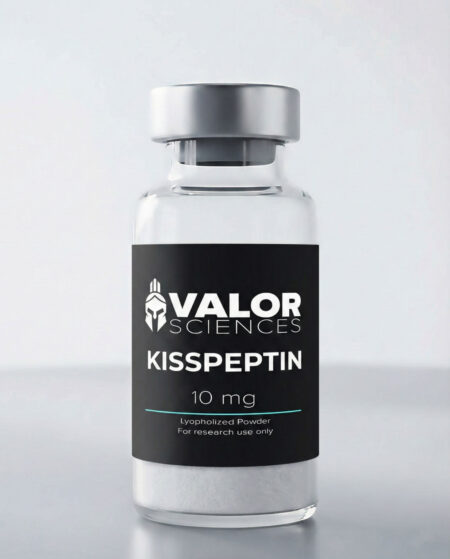
Kisspeptin-10 Research Peptide (10 mg)
Kisspeptin-10 (KP-10) is the biologically active C-terminal decapeptide fragment derived from the full-length KISS1 gene product, Kisspeptin-54 (also known as metastin). The KISS1 gene encodes a 145-amino acid precursor protein that undergoes proteolytic processing to yield a family of C-terminally amidated peptide isoforms—Kisspeptin-54, -14, -13, and -10—all sharing the conserved C-terminal RF-amide motif required for KISS1R receptor activation.
Kisspeptin-10 is the most extensively used isoform in receptor pharmacology and neuroendocrine research due to its minimal sequence length, full receptor efficacy, and favorable aqueous solubility. It has been characterized across a substantial body of peer-reviewed research examining hypothalamic-pituitary-gonadal (HPG) axis regulation, GnRH neuron signaling, reproductive neuroendocrinology, and tumor suppressor biology.
Structural Characteristics
Kisspeptin-10 is a linear decapeptide with the sequence H-Tyr-Asn-Trp-Asn-Ser-Phe-Gly-Leu-Arg-Phe-NH₂, carrying a free N-terminal amine and a C-terminal amide. The C-terminal amidation is critical for receptor binding; removal of the amide group substantially reduces KISS1R affinity. The peptide belongs to the RF-amide neuropeptide superfamily, defined by the conserved Arg-Phe-NH₂ C-terminal motif shared across multiple neuroendocrine peptide families.
Structure-activity relationship studies have identified the C-terminal pentapeptide (Gly-Leu-Arg-Phe-NH₂) as the minimal pharmacophore sufficient for KISS1R activation, while the full decapeptide sequence provides optimal binding affinity and receptor residence time. The tryptophan residue at position 3 has been identified as particularly important for receptor engagement through hydrophobic interactions with the KISS1R binding pocket.
Characterized Signaling Pathways
Published research has identified multiple receptor-mediated signaling interactions:
KISS1R / Gq–PLC–IP₃–Ca²⁺ Signaling Cascade
Kisspeptin-10 binds with high affinity to KISS1R (GPR54), a Gq/11-coupled GPCR. Receptor activation stimulates phospholipase C (PLC), generating inositol trisphosphate (IP₃) and diacylglycerol (DAG). IP₃-mediated endoplasmic reticulum Ca²⁺ release and DAG-dependent PKC activation together drive downstream signaling outputs including ERK1/2 phosphorylation and arachidonic acid mobilization (Kotani et al., Journal of Biological Chemistry, 2001; Stafford et al., Molecular and Cellular Endocrinology, 2002).
GnRH Neuron Activation and HPG Axis Regulation
Kisspeptin neurons projecting to GnRH-expressing hypothalamic neurons represent a critical regulatory node of the HPG axis. In-vitro and in-vivo studies have demonstrated that KISS1R activation in GnRH neurons triggers membrane depolarization and action potential firing, driving pulsatile GnRH release into the hypophyseal portal circulation and subsequent LH and FSH secretion from anterior pituitary gonadotrophs (Seminara et al., New England Journal of Medicine, 2003; de Roux et al., PNAS, 2003).
MAPK / ERK1/2 Pathway Activation
KISS1R engagement activates the MAPK cascade, with studies confirming dose-dependent ERK1/2 phosphorylation in both heterologous expression systems and native cell lines. This pathway has been implicated in KISS1R-mediated regulation of cell proliferation and gene expression programs, and has been studied in the context of the original tumor suppressor characterization of the KISS1 gene product (Kotani et al., Journal of Biological Chemistry, 2001).
Tumor Suppressor / Anti-Metastatic Signaling
The KISS1 gene product was originally identified as a metastasis suppressor in melanoma and breast cancer cell line models, with loss of KISS1 expression correlating with metastatic progression. Kisspeptin peptides have been used as molecular probes to investigate the receptor-dependent mechanisms underlying these anti-invasive effects, including modulation of matrix metalloproteinase (MMP) expression and integrin-mediated cell adhesion (Lee et al., Journal of the National Cancer Institute, 1996; Harms et al., Clinical Cancer Research, 2003).