Description
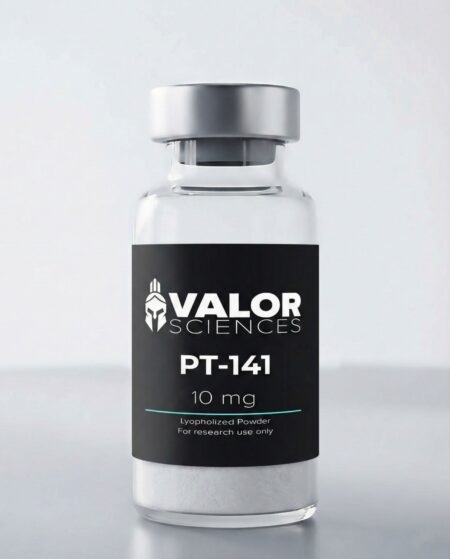
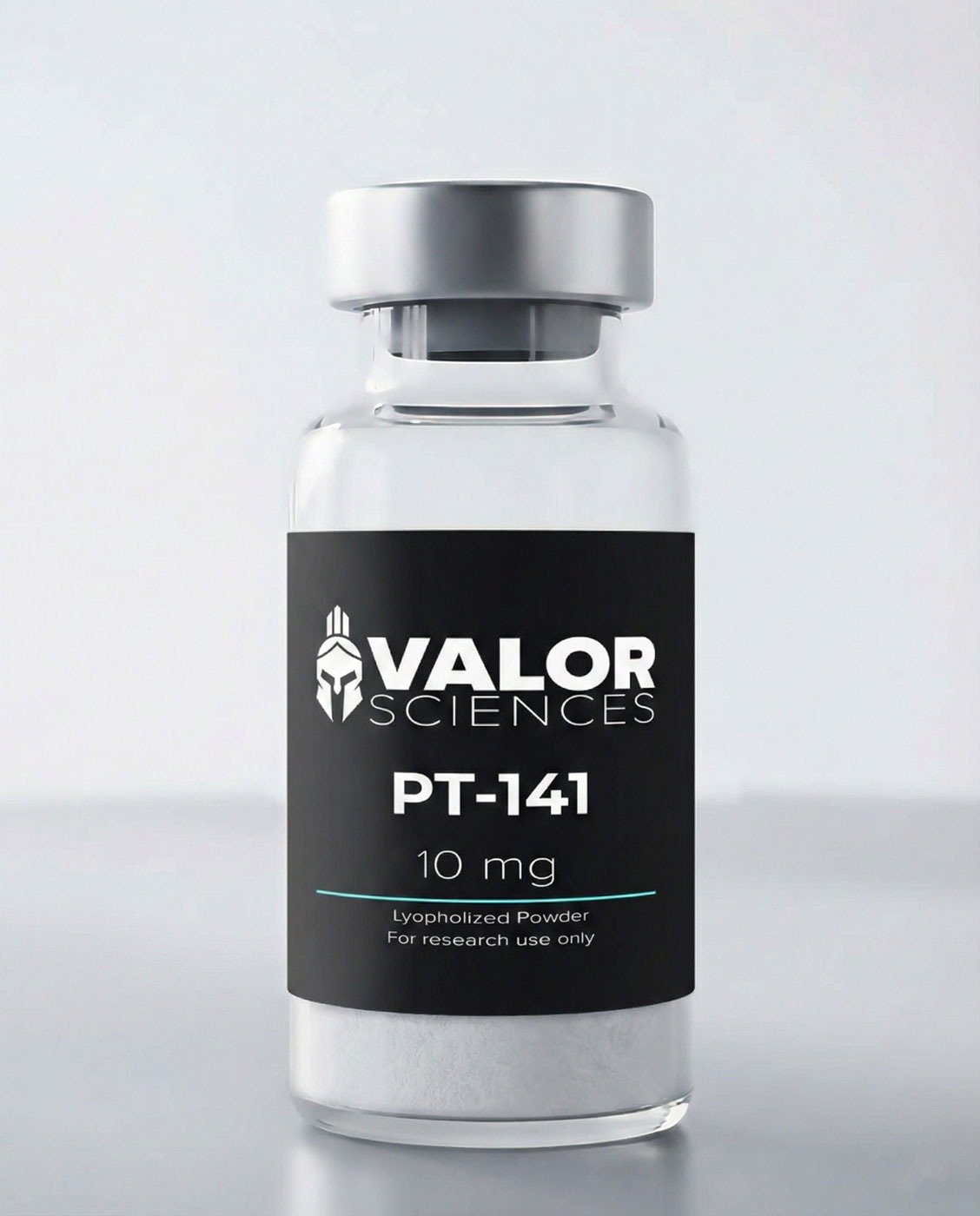
PT-141 (Bremelanotide) Research Peptide (10 mg)
PT-141, also known by its INN bremelanotide, is a synthetic cyclic heptapeptide melanocortin receptor agonist derived from the metabolite of Melanotan 2 (MT-2). It was identified during pharmacokinetic investigations of MT-2 as the primary active metabolite formed following in-vivo hydrolysis of the MT-2 acetyl cap, resulting in a free N-terminal amine in place of the N-acetyl group.
PT-141 has been extensively characterized in peer-reviewed research examining central melanocortin receptor pharmacology, with a particular focus on MC3R and MC4R-mediated neurological signaling pathways. Its receptor engagement profile and CNS penetration properties have made it a widely used pharmacological tool in melanocortin circuit research.
Structural Characteristics
PT-141 shares the core cyclic lactam heptapeptide scaffold of MT-2—cyclo[Asp-His-D-Phe-Arg-Trp-Lys]-NH₂—with a single structural distinction: the N-terminal norleucine residue carries a free amine (H-Nle-) rather than the acetyl cap (Ac-Nle-) present in MT-2. This seemingly minor modification alters the peptide’s physicochemical properties, including its ionization state at physiological pH, and has been associated with differential receptor subtype preference compared to MT-2.
The cyclic lactam bridge between Asp and Lys side chains is retained, maintaining the conformational constraint that confers resistance to proteolytic degradation and stabilizes the His-D-Phe-Arg-Trp pharmacophore in its bioactive orientation. The D-phenylalanine substitution at position 7 remains intact, preserving the enhanced receptor binding affinity relative to native α-MSH.
Characterized Signaling Pathways
Published research has identified multiple receptor-mediated signaling interactions:
MC4R / Central Nervous System Signaling
PT-141 demonstrates high affinity for MC4R, which is densely expressed in hypothalamic and limbic brain regions. MC4R-mediated cAMP elevation in these circuits has been studied in relation to autonomic outflow, dopaminergic modulation, and neuroendocrine regulatory pathways in rodent and primate models (Molinoff et al., Annals of the New York Academy of Sciences, 2003).
MC3R / Hypothalamic and Peripheral Modulation
PT-141 engages MC3R expressed in hypothalamic neurons, brainstem nuclei, and peripheral immune and metabolic tissues. MC3R activation has been investigated in the context of energy balance feedback, natriuretic signaling, and modulation of inflammatory mediator release (Butler et al., Endocrinology, 2000; Renquist et al., American Journal of Physiology, 2012).
Dopaminergic and Nigrostriatal Pathway Interactions
Research in rodent models has shown that central melanocortin receptor activation by PT-141 is associated with increased dopamine release in the medial preoptic area and nucleus accumbens, implicating mesolimbic dopaminergic circuits as downstream effectors of MC4R signaling (Giuliano et al., Journal of Urology, 2006).
MC1R / Pigmentation and Photoprotective Signaling
PT-141 retains MC1R binding activity, and studies have characterized its capacity to activate the cAMP–PKA–MITF axis in melanocytes, driving tyrosinase upregulation and eumelanin synthesis, consistent with the signaling profile shared across the MT-2-derived melanocortin agonist class (Hadley & Dorr, Peptides, 2006).
Research Applications
PT-141 has been utilized as a molecular probe in controlled experimental systems examining:
- Central melanocortin receptor pharmacology (MC3R, MC4R)
- Hypothalamic and limbic circuit characterization
- Mesolimbic dopaminergic pathway modulation
- Autonomic nervous system signaling models
- Neuroendocrine regulatory pathway research
- Melanogenesis and MC1R-mediated pigmentation signaling
- Energy homeostasis and metabolic feedback models